

The Age of False Geniuses: Why Our Culture Mistakes Power for Insight

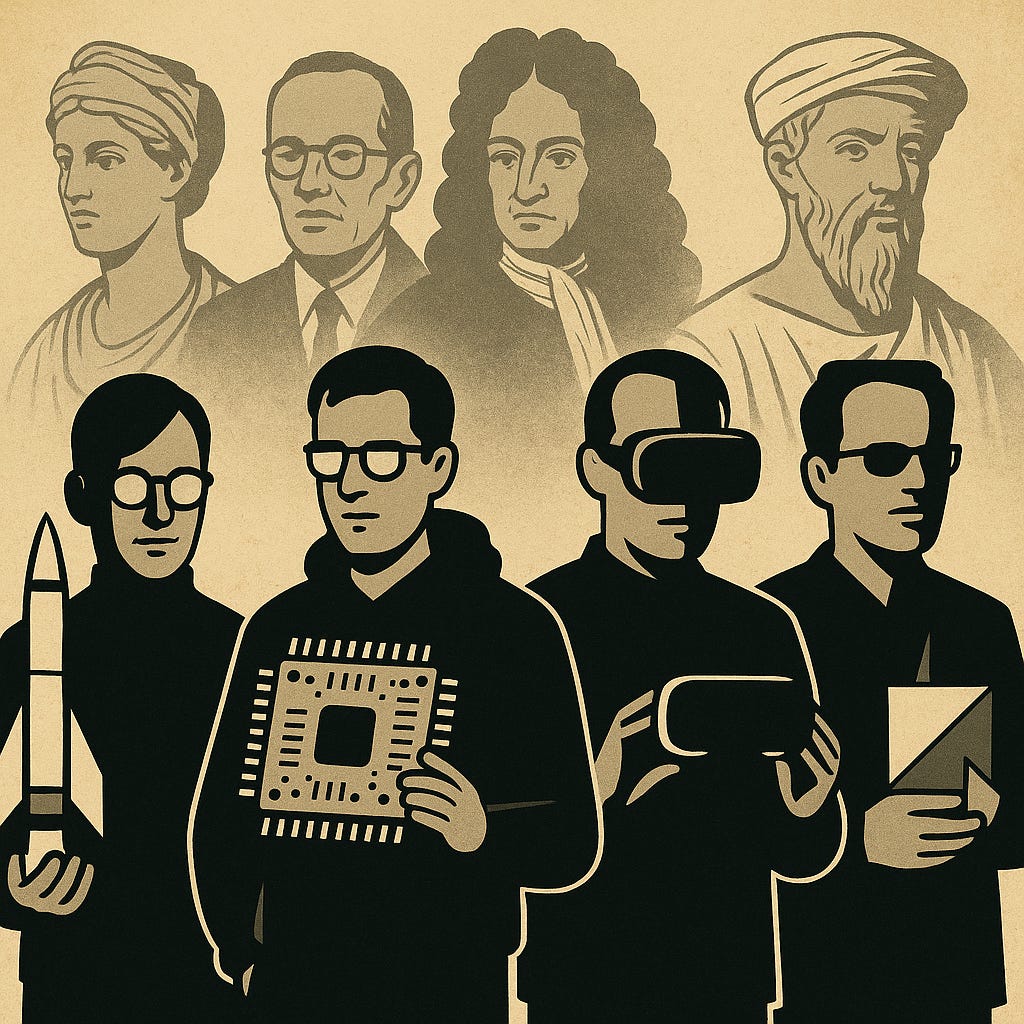
We live in a society that thinks genius can be measured with a bank balance.
Every week, someone from the billionaire class offers a sweeping vision of what consciousness “really” is or what humanity “needs” to survive. These aren’t modest proposals. They’re cosmologies—delivered with the confidence of someone accustomed to being right in one narrow arena and treated as right in all of them.
The strange part isn’t that they speak.
It’s that we listen.
Headlines elevate every claim, as though fortune were a philosophical credential.
The absurdity doesn’t land because it’s ambient. In a materialist society, material success becomes the master key. If the world is made of stuff, then those who collect the most of it must understand the world best. That assumption quietly shapes everything.
And it leads to one of our era’s biggest cognitive mistakes—the Swiss Army Knife fallacy: one sharp blade becomes the whole toolbox.
Build a rocket: must understand metaphysics.
Dominate logistics: must grasp consciousness.
Scale a company: must know what civilization needs to thrive.
We treat domain-specific mastery as a universal passport to wisdom.
But the problem runs deeper. Our definition of intelligence has collapsed into dominance. What we now label “genius” is often just visible-target performance amplified by machinery.
The Bias Hiding Inside Their Big Ideas
The philosophies we hear from the billionaire class almost always mirror the industries that made them powerful. Their “big ideas” aren’t rooted in real metaphysics. They’re shaped—often unconsciously—by the methods and incentives of their own success.
The engineer who builds rockets ends up with an engineer’s metaphysics: consciousness becomes computation, society becomes a system to optimize, and the future becomes a logistical problem best solved by escape velocity.
The platform builder sees humanity as a network: people become nodes, community becomes data architecture, and meaning collapses into metrics.
The efficiency maximizer, trained in scale, naturally concludes that the highest good is whatever accelerates. Ethics become throughput. Leadership becomes centralization.
None of this is grounded in philosophy. It’s just predictable. A person’s background becomes their ontology. Their business model becomes their worldview.
How Expertise Turned Into Omniscience
Give someone enough money and the halo effect activates. Competence in one domain becomes presumed competence in every other, as if expertise naturally spills into whatever topic is nearby.
Tech culture amplified this confusion. Efficiency began masquerading as insight. Optimization drifted into philosophy. The ability to manipulate systems was treated as evidence of understanding reality’s structure. Academia mirrors the mistake; a physicist publishes on metaphysics and the world behaves as though specialization transfers by osmosis.
But it rarely does.
Schopenhauer captured the distinction: talent hits a target no one else can hit; genius hits a target no one else can see.
We’ve inverted that wisdom. Someone hits a visible target with force, and we imagine they must also perceive the hidden ones.
But talent is not perception. Optimization is not understanding. Scale is not wisdom.
And yet we follow these figures—to Mars, to the metaverse, to whichever escape hatch is trending—while the problems we actually face accumulate behind us.
A society that can’t distinguish intelligence from influence will always elevate the wrong voices.
The Forgotten Definition of Genius
We’ve come to treat genius as cognitive horsepower—more acceleration, more clever moves per second. But that definition shrinks the thing it tries to capture. Performance isn’t genius. It’s just performance.
Real genius is a way of seeing. It’s the capacity to notice the structure behind appearances—the pattern that organizes the patterns. Most people navigate the map; a genius senses the coordinate system beneath it.
Consider the lineage.
Kurt Gödel didn’t simply prove theorems—he revealed the fault line running through formal systems themselves.
Gottfried Wilhelm Leibniz didn’t merely calculate—he intuited a universe made of minds, each soul a window onto the whole.
Pythagoras didn’t invent harmony—he heard mathematics vibrating inside the world.
Perception at that depth unsettles the stories a culture depends on. It makes the familiar feel provisional again.
That’s the signature of genuine genius—not acceleration or dominance, but clarity: the ability to see the frame the rest of us mistake for the world.
Why Real Genius Threatens Power
If this were only a definitional issue, the stakes would be small. But real genius destabilizes.
Genius that sees deeply doesn’t reinforce the existing order—it dissolves it. It cuts through the myths that prop up authority and exposes the scaffolding beneath them. Systems built on dominance instinctively distrust anyone who can perceive the frame they depend on.
If your authority requires the illusion, you fear the person who perceives the structure.
History follows the same pattern.
Georg Cantor pushed too far into infinity and was institutionalized.
Nikola Tesla imagined a different technological order and was dismissed.
Hypatia of Alexandria taught a cosmology that threatened power and was murdered.
Cultures don’t silence such minds for being wrong. They silence them because what they see makes the inherited order feel provisional.
The Courage Behind Clear Thinking
There’s another dimension of intelligence we rarely acknowledge: the nerve required to follow a thought all the way through. Seeing clearly is one skill; standing by what you see is another.
Most gifted people learn to soften their conclusions—stay inside the consensus, avoid the friction that comes from naming what others aren’t ready to confront. Insight is easy to edit when approval is the reward.
The few who don’t are the ones who shift the arc of a civilization. They follow a line of reasoning past its social comfort zone, refusing to sand down an idea just to make it palatable. For them, reason isn’t a strategy—it’s an obligation.
And that steadiness carries risk. Cultures punish those who disturb their sacred stories. Yet this is the quiet backbone of genuine genius: a loyalty to clarity that holds even when the world pushes back.
The Civilization We Could Build If We Chose Clarity Over Wealth
Part of the tragedy is that the minds capable of real insight rarely resemble the people a materialist society is trained to admire. They don’t chase platforms. They don’t cultivate followings. They aren’t performing their intelligence. They’re simply thinking—quietly, steadily—beyond the point where applause usually stops.
But in a worldview that treats matter as the ultimate reality, those who control the most of it become the default oracles. Wealth becomes a proxy for wisdom. Velocity becomes a proxy for vision.
And yet attention can be retrained. If clarity—not accumulation—became the signal we listened for, we’d begin noticing the thinkers attuned to the patterns beneath the noise, the ones who don’t need an audience to recognize truth.
Civilizations rise or fall on what they treat as intelligence. Ours has mistaken influence for insight long enough. A wiser world won’t be built by the loudest performers, but by the minds that never asked for a spotlight—only the freedom to see clearly.