

The Language Beneath All Languages: Part 2
The Shape of Our Thoughts (And Why It Matters More Than What We Think)

Preface
This essay is part of an ongoing five-part series exploring a single question from multiple angles: what if thought itself has a structure—and what if understanding that structure is the key to clarity, coherence, and the possibility of thinking together again?
Each part builds on the last. If you’re joining midway, you can read this piece on its own, but the ideas are cumulative. Earlier entries lay the groundwork for what follows, moving step by step from language, to thought, to coherence, to relationship, and finally to the wider ambition of making the soul legible without reducing it.
Here are the previous entries in the series:
Part 1: The Philosopher Who Wanted Us to Stop Arguing and Start Calculating
An exploration of Leibniz’s unrealized dream of a universal language—and why the failure of language may point to a deeper structure beneath it.
Structure Before Meaning
Here’s the counterintuitive part.
You might think that if thoughts are waves, and every mind is a vast interference pattern, then understanding anything about the mind would require decoding an impossible ocean of oscillations.
But that’s not how it works.
You don’t need to know what someone is thinking to know how well they are thinking.
You can know a guitar is in tune without knowing the song.
In EEG, one way this deeper structure becomes visible is through a pattern called a 1/f slope. To see it, we use a mathematical lens called a Fourier transform, which is just a way of breaking a complex signal into the pure frequencies that make it up—much like splitting white light into a spectrum. Ontological mathematics tells us the same thing at a deeper level: any thought can be expressed as a sum of perfect sine and cosine waves. Then we average that distribution over several minutes of stillness, letting transient patterns come and go.
What remains is the persistent part of the signal. Think of this as revealing your thinking style.
A healthy, flexible brain—the kind that supports rational, adaptive thinking—shows a smooth decay of power from slow to fast frequencies. No huge spikes. No gaping troughs. Just a graceful gradient.
Life distorts it.
Trauma leaves its imprint as rigidity—exaggerated peaks at specific frequencies, as if the nervous system has become obsessed with re-playing a certain rhythm. Aging tends to flatten the slope, with possibility hardening into habit. Certain forms of anxiety carve out little islands in the spectrum—loops the system can’t stop running.
These aren’t metaphors. They’re literally there, in the data.
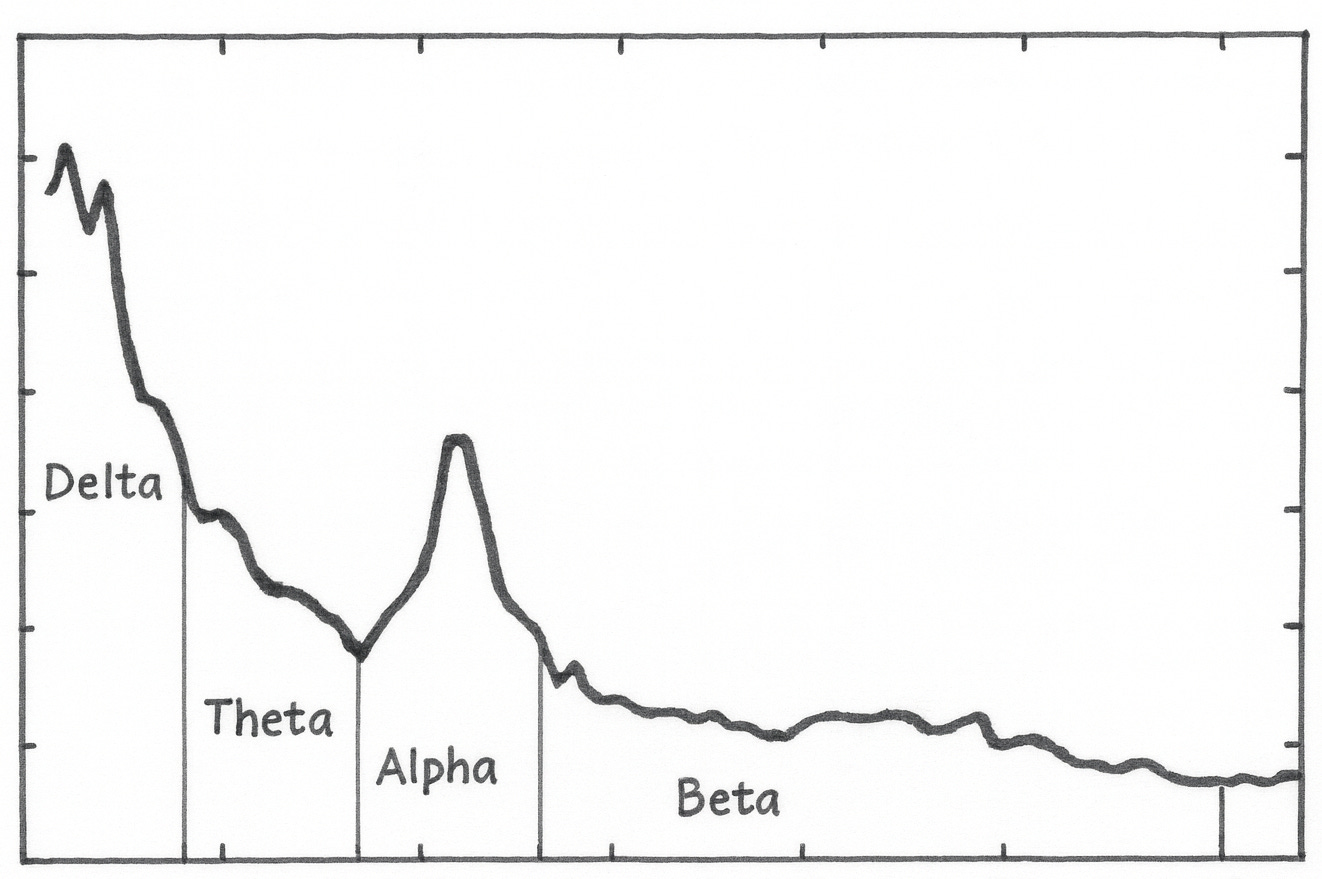
A realistic FFT spectra showing the 1/f distribution at a single scalp location of an EEG. The y-axis is power in microvolts, the x-axis is frequency. Notice the jagged distortions to a smooth theoretical power=1/frequency distribution.
Leibniz envisioned the domain of physical existence as everything that occurs where x>0 and x<∞—a finite interval framed by infinities. Beyond those limits, he believed, lay the territory of mind. Put less technically: he drew a conceptual line between a finite world of matter and an infinite field of mind that contains it. I often wonder whether we are seeing an echo of that same structure in the brain’s 1/f curve: a smooth, continuous decay across frequencies, jagged only where life has bent it. In other words, a pattern that might represent the ground state of being—a quiet, elegant baseline from which the infinite potential of becoming emerges.
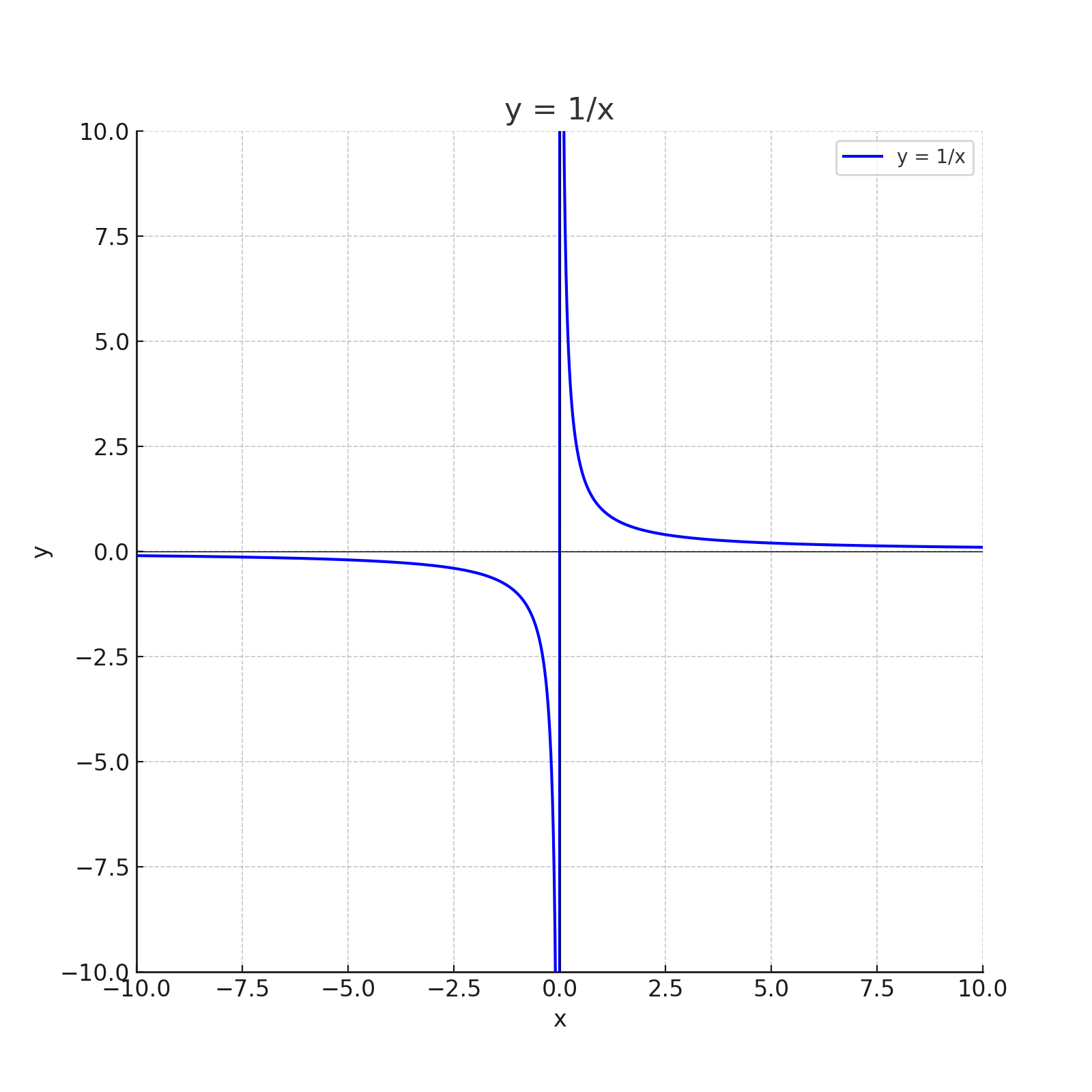
Leibniz envisioned the physical universe to exist where x>0 and x<infinity. Could we be looking at the same pattern?
From the perspective of ontological mathematics, this makes a certain kind of sense. The brain is not the generator of mind, nor a miniature copy of it, but the reflection created at the intersection of an individual soul with the shared, physical domain. It’s where infinite internal dynamics pass through the bottleneck of finite embodiment. The mapping is not 1:1—nor could it be—but even this partial reflection is revealing.
The electrical activity of the brain seems to carry the same syntax as the mind itself: the same logic of waves, the same interplay of rhythm and relation, the same patterns of order and distortion. To measure the intersection is not to measure the soul, but it may be the closest measurable shadow of its structure we’ve ever had.
When I sit with a QEEG map of a client’s brain, I’m not reading their thoughts. I’m reading the syntax beneath them. I’m seeing how their baseline thinking style has taken shape—how the system has compensated, hardened, numbed, clenched, or over-learned. I’m seeing where the brain can no longer recruit neurons for a task and then release them when it’s done. I’m seeing where the language of thought has become cramped, brittle, or drowned in noise.
A flexible brain is one that can move.
A rational brain is one that can move without distortion.
Native rationality, in this view, isn’t a cold, detached thing. It’s not mere cleverness or quick logic. It’s not the brittle performance of intelligence we’ve been taught to admire. Rationality is broader, deeper, quieter than that.
At its core, it includes flexible thinking—but it isn’t exhausted by it. Flexibility is the entry point, the precondition. Without it, reason collapses into repetition. A mind that cannot move cannot discover. A mind that cannot loosen its grip cannot learn. But once flexibility returns, something else becomes possible: the ability to follow a thought all the way to its source, to revise a belief without losing oneself, to let structure, not fear, guide the next step.
Rationality is the capacity to align thought with reality’s underlying order. It is self-correction without self-punishment. It is coherence without conformity. It is the willingness to let clarity overrule habit, even when habit feels safer.
Seen this way, rationality isn’t cold at all. It’s warm with possibility. It is a flexible syntax—unencumbered by biases that were never truly yours—able to update, revise, explore, and settle without getting stuck. And once the syntax is free, the mind begins to reveal its actual intelligence, the one that was always there beneath the distortion.
We don’t need to fix the story first.
We need to fix the signal.
Coming Next…
If frequency and amplitude reveal the ingredients of thought, and the 1/f curve shows their overall shape, then the next question is how these elements interact. Structure isn’t static. Thought is choreography.
Engaging reflection - I look forward to following the series.